

Jedîyah

Sacred text of Sirâ

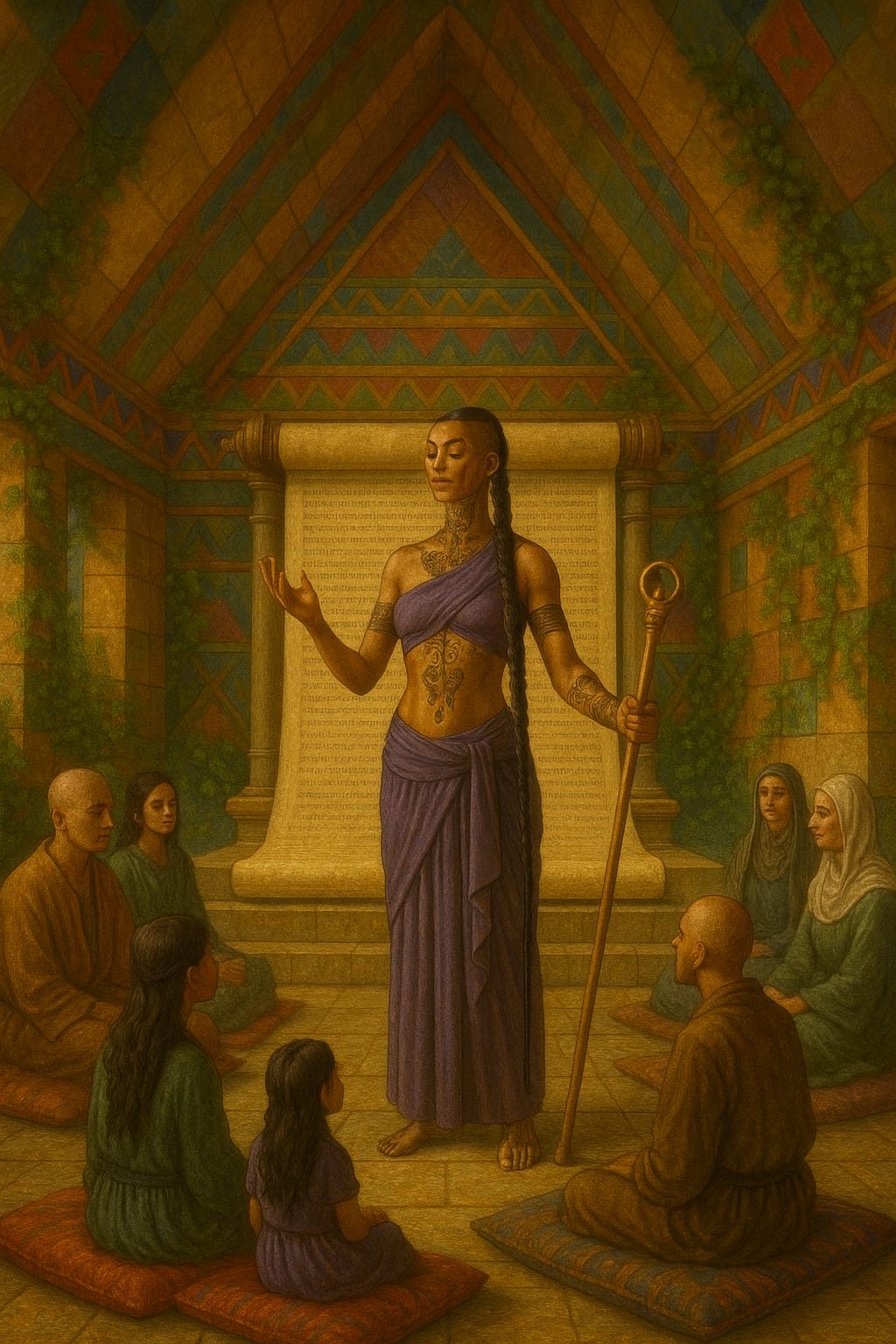
The Jedîyah is the sacred text of Sirâ. It expands the Short Road and is also a guide to rebuild civilization.

This site does not reproduce the Jedîyah in full. What follows are established teachings drawn from it — and from the living tradition that holds it — so a stranger may understand the shape of the religion without invented commentary.

Pull-quotes

Being exceeds the visible.
The visible world is not the boundary of being.
What is seen is not the whole of what is; beyond the veil of form, existence continues.
You may journey toward Šahanû without end, for no path can bring you to what cannot be reached. And yet there is nowhere you have ever been where Šahanû was absent. You seek what is beyond arrival, while already abiding within it.
We strive to understand Šahanû and, as a reflection, all of existence as a child might reach for clouds — not because we can reach them, but because by reaching we grow and evolve.

What the text holds

On authority A sacred text can preserve wisdom about the divine without becoming identical to the divine. Mistaking representation for reality — even a faithful description — is the deeper form of idolatry. Seek knowledge relentlessly; never confuse your present model of reality with reality itself.

The Sacred Tome of the Sernî

Thirty-nine chapters in seven books. Set down in the Year 6739 of the Count, on the Ninth Day of the Twelfth Month.

Contents

Book One — The Book of Heat

1. The Opening Word
2. Of Tabira, the First Heat
3. Of the Stars Who Forge
4. Of Kira, Askr and the Wheel of the Sky
5. Of Šahanû, the One Ahead
6. Of Life and the Living Flame
7. Of the Own Flame and the Shared Fire

Book Two — The Book of the Turnings

8. Of the Ak'Bešah, the Great Turnings
9. Of the First Ones Before the Fall
10. Of the Forgetting and the Images
11. The Long Road: The Two Rivers and the Mountain of Seven Walls
12. The Long Road: The Black Land
13. The Long Road: The Grass Sea
14. The Long Road: The Western Sea
15. The Road to the Stars

Book Three — The Short Road

16. The Short Road: Codes One to Ten
17. The Short Road: Codes Eleven to Twenty

Book Four — The Book of the Eight Protocols

18. The First Protocol: The Living Flame
19. The Second Protocol: The Bond
20. The Third Protocol: The Clean Vessel
21. The Fourth Protocol: The Unbent Word
22. The Fifth Protocol: The Measure
23. The Sixth Protocol: Kor
24. The Seventh Protocol: The Open Road
25. The Eighth Protocol: The Stars

Book Five — The Book of the Inner Work

26. Of the Standing Stillness
27. Of the Working
28. Of the Two Flames: Science and Mysticism
29. Of the Mejâ and the Mejerû

Book Six — The Book of the House and the People

30. Of Kin, Joining and the House
31. Of Children, Teaching and the Twentieth Year
32. Of the Body, Food and the Beasts
33. Of the Warrior in the Garden
34. Of Law, Judgment and the Worthy
35. Of Strangers, Allies, Enemies and Sacred Deception
36. Of Words, Names, Stories and the Arts
37. Of Work, Making and Progress Without End

Book Seven — The Book of the Turning Year and the Unending Life

38. Of the Year, the Days and the Rites
39. Of Life Unending, the Long Remembering, and the Closing Word

From Chapter 1, “The Opening Word” — I. The Candle and the Flame

1 Before the road, before the wind, before the names of the people and the count of the years, there is this: a candle on a table, and a flame upon the candle.

2 Set one before you now, if you have one. If you have none, remember one. Every sernî has seen a candle lit. Every child has watched the small fire lean when a door is opened and stand up straight again when the door is closed, as a child leans toward a voice and then remembers to stand tall.

3 Look at it. You do not ask what it is. You do not reason your way toward it, saying, “Here is warmth, and here is light, and the wax is going down, and so perhaps this thing before me is fire.” You know it at once, before any reasoning, the way you know your mother's voice in a crowded hall. Fire knows fire.

4 This is the first teaching of the Jedîyah. It is set at the very door of the book because every other teaching stands upon it, as every wall of a house stands upon the ground that was laid before the walls:

The flame upon the candle is the infinite choosing to be intimate. So it is with Šahanû and us. His light within our soul. But even when intimate He remains infinite, and our soul is both the candle and the flame.

5 Hear it again, slowly, and let each part be weighed.

6 Fire is one; flames are many. The heat that burned in the beginning of all things, which the sernî call tabira, the First Heat, is the same heat that runs in the heart of Kira the Sun, the same heat that rises in your own chest when you climb a hill, the same heat that sits on the wick before you. There are not many fires in the world. There is one Fire, wearing many shapes.

7 The flame on the candle is no painting of fire and no sign pointing toward some greater fire far away. It is fire, the true and whole thing, wearing a small shape so that it can sit on a table among bread and cups and the hands of children and not burn the house.

8 Fire made small is fire made kind. The sernî call this the mercy of form. The great fire of a forest cannot be brought indoors; the fire of Kira cannot be held in the hand; but the same fire, given the shape of a candle flame, can light a page for a child learning her letters and warm the fingers of an old man mending a harness. Nothing of its nature has been lost. It has only been measured out, so that it can be near.

9 So it is with Šahanû. He is the First Heat that knows itself, the living current of the universe toward more life and more knowing, the One Ahead on the Road. He is greater than every star, older than every atom, wider than the widening of the sky. And He chooses to burn small, within each one of us, in the shape of a soul.

10 Do not think that because He is near He is made less. Light a candle from a candle, and the first does not grow dim. Light a thousand from the first, and still it burns as it burned before. A flame is a working, a giving of heat and light that passes itself on; it is not a store that is spent by sharing. So the light of Šahanû in you takes nothing from the light of Šahanû in your brother, or in the stranger at the gate, or in the farthest star. He is wholly present in the small flame, and He is wholly infinite, at once, and the one truth does not crowd the other.

11 And our soul is both the candle and the flame.

12 The candle is the particular self: this body and no other, this name, this voice, this way of laughing, these hands that learned these crafts, this one life with its own beginning in the womb and its own road. The candle is unrepeatable. There was never one like it and there will never be one like it again. It is to be guarded and made strong, and the people labour toward the day when no candle need be spent at all. But while that work is unfinished, when a candle is spent it must be grieved, because something precious has gone out of the world that the world cannot make again.

13 The flame is His light burning in the candle. It is the part of you that knows fire when it sees fire, that leans toward what is good as the flame leans toward the open door, that rises upward whatever way the candle is turned.

The full text of the Jedîyah is not yet published here. The Temple quotes it where its words are needed — in the Virtual Temple, the Halls and the Short Road. Full reader coming soon