Sirâ — master by eight portions
Organized 13 September 2026 from what Elinarah has set. Nothing below is a proposal unless it is marked open or not yet set. The eight protocols of Sirâ exist and have been renamed and refined; their contents are not filed. These eight portions are a different frame. Do not treat them as the protocols.
Names Elinarah has set for this frame: hasszar (law), Jedîyah (sacred literature), Mejâ (priestesses and priests), the Golden path (the mission). Temples are the Mejerû. Jedîya and Majâ are misspellings and are not used.
1. A doctrine concerning God, the universe, and humanity
Šahanû
Šahanû is the name in Seren thought for the ultimate divine reality: not a god among gods, not a supernatural person with a fixed shape or personality, and not something that can be completely enclosed by definition. Šahanû is the divine essence beyond definition — the reality beneath and beyond what can be seen, categorized, named, or fully understood.
Calling Šahanû “God” is useful only as an approximation, and only as outsider shorthand: our notion of God, god, or deity. The word misleads if it suggests a humanlike ruler, a body, a narrow domain, or an ordinary mythological personality. Šahanû is not merely a being within existence; Šahanû points toward the deepest nature of existence itself.
No description is identical with Šahanû. Every statement remains incomplete. Theology should not declare what Šahanû looks like, what gender Šahanû is, where Šahanû physically resides, what finite personality Šahanû possesses, or what limited category Šahanû belongs to. Such statements risk turning the indefinable into an idol of language.
Core formulas (verbatim):
- The visible world is not the boundary of being.
- What is seen is not the whole of what is; beyond the veil of form, existence continues.
- Being exceeds the visible.
These are not merely claims that invisible things exist. Reality is greater than the portion available to ordinary perception. Šahanû names the ultimate depth behind that truth.
Journey primer (verbatim):
You may journey toward Šahanû without end, for no path can bring you to what cannot be reached. And yet there is nowhere you have ever been where Šahanû was absent. You seek what is beyond arrival, while already abiding within it.
Posture (verbatim sense):
We strive to understand Šahanû and, as a reflection, all of existence as a child might reach for clouds — not because we can reach them, but because by reaching we grow and evolve.
Šahanû is recognized and contemplated. Šahanû is not worshiped. To worship Šahanû is blasphemy, because worship implies boxing Šahanû in or defining Šahanû in limited terms. A word, a doctrine, or an institution can become an idol if it is mistaken for Šahanû.
The sernî kneel to none, Šahanû included. They follow those worthy. They are not anti-authority. They are no one’s slaves and no one’s servants.
Ethics are not to be presented as personal decrees spoken by Šahanû unless Elinarah establishes that.
The primal essence (Jedîyah)
From the sacred texts of the Jedîyah (Elinarah, 13 September 2026). This passage does not name Šahanû. Whether the primal essence and Šahanû are one is for Elinarah to say. The Testament of Morann is named as a comparison; whether it is sernî is not confirmed.
The primal essence that pervades all existence is beyond the grasp of conventional worship and understanding. It is written:
To name it is to limit the limitless; to worship it is to confine the boundless.
This essence, existing beyond the dualities of name and form, substance and void, cannot be captured by any thought, word, or deed. It is the ineffable root of all being, the silent foundation upon which the cosmos dances its endless dance.
The true nature of the primal essence is unknowable. It eludes the net of our simplest descriptions and defies the sanctuary of our sacred spaces. In its presence, the sages and seekers of the Jedîyah do not bow their heads in prayer, nor do they raise their voices in song; they sit in silent awe of that which cannot be confined by the mind's reach.
The universe
The visible is not worthless and not the whole. Transcendence does not despise matter, family, civilization, or ordinary life. Knowledge is to be sought relentlessly, and the present model of reality is never to be confused with reality itself. Knowledge is emergent. The Jedîyah is a starting point, not the close of the journey.
Death marks the disappearance or transformation of a visible form. It does not prove the annihilation of being. Visible cessation does not prove ontological nonexistence. There is no complete map of what lies beyond the veil of form.
The Ak'Bešah — the day of cataclysm — is the cycle in which, every six thousand years, Earth is hit by pole shift and micronova and humanity is thrown back to primitive times. Humanity has had advanced technology many times. Elinarah expects the next around the early 2040s, in agreement with Ben Davidson.
The sernî came from another world. They are drawn to the stars, especially Orion.
Not yet set: a full cosmology of that other world; whether the Ak'Bešah is taught as doctrine, history, or both; any map of what lies after death.
Humanity
Life participates in a reality whose ultimate limits are unknown. The Sirâ formulation of the meaning of life (philosophy within this metaphysics, not an automatic command from Šahanû):
Create life. Preserve life. Expand life. Evolve life. Transcend life.
Life exists before birth: babies are alive in the womb. This is now held more strongly: life begins prior to conception. See below.
Life before conception
Life is sacred and begins prior to conception. Once conception begins, a powerful being has made its way into the world, and society has a responsibility to guard and protect it.
The baby speaks to the tribe from the womb. With every heartbeat she says: Prepare the world for me. I am here.
Children send their parents forward to make way for them.
Sirâ is staunchly for life and opposed to abortion. Abortion is murder, except when it is done to protect the life of the mother from imminent death. Even in that case it is still considered killing a living human. Life is sacred.
Sirâ forbids the consumption of animals, alcohol, and drugs (including smoking). These are forms of destruction and being an accomplice to death.
The people may not watch, read, or listen to media designed to glorify violence, evil, and depravity. These are poisons to the soul. They must be avoided, and where the people hold the power they must be erased from existence. This is not the same teaching as the media-disclaimer law (which lets certain tropes survive with explanation).
The first of men is Zarûd. The first of women is Dâyatirî.
The people through whom this doctrine is lived are the Sernî (portion 8). Humanity also includes those who remain on Earth and those who may be led toward the stars (portion 7).
2. A morality for the individual and society
The Short Road is the children’s code: simple versions of the greater philosophies, easy to memorize and repeat, a stepping stone to the Jedîyah. There are twenty codes because twenty is the base of the counting system, the age childhood ends, and the number of completion. Twelve are written. Thirteen through twenty are not.
The twelve
- Family First
- Life For Life's Sake
- We Were Born On The Back Of The Wind, And That Is Where We Shall Remain
- Run, Hide, Fight
- We Don't Start Fights; We Finish Them
- It Is Better To Be A Warrior In A Garden Than To Be A Gardener In A War
- We Follow Those Worthy; We Kneel To None
- We Remain Healthy In Body, Mind, And Spirit; We Take In Nothing That Would Diminish Them
- Movement Is Life; Expand Or Die
- The Enemy Of Your Enemy Is Your Tool; Use Them Wisely
- We Do Not Trade Life For Land
- Your Word Is Only Worth As Much As The One You Give It To; Choose Who Can Trust Your Word Wisely
Meanings Elinarah has set
Family First. Kin outrank everything, including the sernî as a whole. The law itself agrees: between the law and my mother, I choose my mother.
Life For Life's Sake. Life is sacred and self-justifying. You never have to justify existing or living. There is no point at which a life stops being worth living, or at which life in general becomes bad. Why bring children, extend lives, breed new animal species? Because it creates more life. That answer is its own explanation.
Back Of The Wind. Travellers, permanently, with no loyalties to land.
Run, Hide, Fight. Knowingly teaches more battle-avoidance than the culture actually practises. A child sometimes needs a slightly skewed lesson as the foundation for a more accurate one later. It keeps children safe and lays groundwork for peaceful-until-provoked.
We Kneel To None. Includes leaders and Šahanû.
Expand Or Die. Numbers, territory, knowledge, and so on. Moral limits on expansion live in the sacred book.
Life before birth (on the ideas list for the remaining codes): babies are alive in the womb.
Life prior to conception (set). Life is sacred and begins prior to conception. At conception a powerful being has entered the world; society must guard and protect it. The baby speaks to the tribe from the womb. With every heartbeat: Prepare the world for me. I am here. This may still also be one of the ideas the open codes must carry; Elinarah has not said whether it already has its own line.
What the eight open codes still have to carry
Self-respect and pride; progress; deep respect for animals that does not surpass respect for people; adaptation; life before birth; sacred deception; respect for the dead; resilience and not giving up; the importance of words and names.
Nine ideas, eight slots. Not settled which pair shares a line, or which line is written.
Candidates, none settled: “Progress Without End,” plus a second part barring progress bought by immoral means or unnecessary harm to innocents; “The Road Is The Wheel” / “The Road Is The Wheel; We Keep Turning”; “Walk The Road”; “We Are The Noble Tricksters Who Practice The Art Of Sacred Deception.”
Cut. Do not bring back: “Run First, Hide Next, Fight Last And Fight Fiercely” (compressed into 4); “Peace As We Can, War Without Hesitance.”
Doctrine and defence
The philosophy grows from it is better to be a warrior in a garden than a gardener in a war: strength, discipline, and readiness in peacetime.
Every single sernî must have the potential to be lethal to their enemies. Universal, not a warrior caste.
Children are not left unattended and almost never fight. If they must, they fight as brutally as they can — including ripping ears off — with regard only to their own survival, the survival of those around them, and getting away before the attacker can follow.
Mercy matters; mercy does not require permitting predation upon innocent life. Absolute “turn the other cheek” is rejected. Compassion without preservation can become surrender. Preservation without compassion can become cruelty.
Peace is evil when it means failing to defend the people against evil and enemies. Peace is ideal when all is in alignment. War is best and most beautiful when the people are under attack from foes who would see them destroyed in body or soul.
Markers of how a sernî lives this morality
No alcohol. No meat. No drugs or smoking. This is not only a marker: consumption of animals, alcohol, and drugs (including smoking) is forbidden as destruction and being an accomplice to death. (Sits with code 8.) Drawn to ancient cultures: Sumerians, Egyptians, Phoenicians, Etruscans, Scythians, Seres. Drawn to the stars, especially Orion.
3. A regimen of rite, custom, and ceremony
Set:
- Recognition and contemplation, not worship. No kneeling — not to leaders, not to Šahanû.
- Jedîyah: seekers do not bow in prayer or raise voices in song; they sit in silent awe of the primal essence.
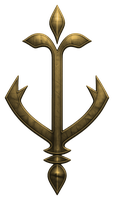
- The temple symbol is also used for meditation.
- Temples are the Mejerû: places to learn, argue, consult, and contemplate — not to submit.
- Twenty organizes a life: end of childhood, the mandatory programme (survival, life skills, knowledge of the law — not school), dating minimum.
- Houses. Each house has a dejr. Each person has a personal dejr. House Korah is the ruling house.
- Extended family raising children is normal.
- Learning is by family, tutors, skill classes, apprenticeships, college-like study, and online learning — not school as the usual taking of the child out of the family for the day.
- šabtû is the rest day.
- Days begin at sundown. Weekday and date both advance at sundown.
- Orphans’ Day, marked with a silver star, falls on 3 nakaša.
- Sibling address by sex and birth order exists as a custom. The terms are not set.
Not yet set:
- The contents of the eight protocols (the obvious carrier for practice, and still unfiled).
- What, exactly, is done in a Mejerû besides learn / argue / consult / contemplate / meditate.
- The Seren name of the temple symbol.
- Ceremonies of twenty, of joining a house, of the dejr, of šabtû, of Orphans’ Day, of birth, of the dead.
- How recognition of Šahanû is enacted without becoming worship.
4. A body of law — hasszar
Set:
- The name of this body of law, in this frame, is hasszar.
- Kin outrank the law and outrank the sernî as a whole. The law itself agrees.
- Those worthy are followed by choice, revocably. Nobody is knelt to at any tier.
- Land is owed no loyalty and is never worth a life.
- It is law that media of this kind carries a content disclaimer: a compromise that lets beloved cartoon tropes survive. The disclaimer lists the dangerous or not-great behaviour and explains, briefly but as more than “this is bad,” why children should not copy it.
- In sernî scientific consensus, cats are dangerous. They are kept around only to avoid Black Plague situations and otherwise avoided. The law requires a cat disclaimer at the start of anything depicting them.
- Ident numbers are twelve digits: four-digit year, two-digit moon code, two-digit day, four-digit sequence, and a mod-11 weighted check character.
- An enemy loses all rights of ownership. Their possessions are forfeit. (Who counts as an enemy is not yet defined.)
- It is right and good to deprive an evil person, people, or entity of its wealth and power: this blocks the evil from spreading and clears the path for what is right.
Not yet set:
- The written hasszar as a code (statutes, courts, how a family enforces when kin outrank the law).
- The name of the armed forces. Working candidate only: Sernî Defense Forces.
5. A sacred literature — Jedîyah
Set:
- The sacred tome is the Jedîyah. Elinarah is writing it.
- It expands the Short Road from the child’s version into adult reasoning.
- It is a guide to rebuild civilization, tied to continuity through the Ak'Bešah.
- The moral limits on expansion (so that codes 9 and 11 can be held together) live here.
- A symbol may point toward Šahanû. A sacred text can preserve wisdom about the divine without becoming identical to the divine.
- Knowledge is emergent. The Jedîyah is a starting point; the journey of knowledge must continue from there. It is to be read with a questioning heart. From beginning to end, ask what it could do better — and seek that.
- Established passage on the primal essence: “To name it is to limit the limitless; to worship it is to confine the boundless.” Beyond name and form, substance and void. Unknowable. Silent awe, not prayer or song. Names the Testament of Morann as a comparison (link not confirmed).
Not yet set:
- The inner structure, books, or chapters of the Jedîyah.
- The text of the expansion of each Short Road line.
- The moral limits on expansion, in their settled wording.
- Whether other writings (the primer on Šahanû, the Short Road as recited, N'jakr as diary) are inside the Jedîyah, beside it, or neither.
6. Institutions through which the foregoing find expression — the Mejâ
Set:
- The Mejâ are priestesses and priests (earlier: Mejâ, clergy). They are scholars, keepers, and interpreters — not intercessors. In a kneel-to-none people they cannot broker submission, because there is no submission to broker.
- Temples are the Mejerû.
- Sernî belong to houses. House Korah is the ruling house.
- The programme at twenty is a standing institution of the people, not a school.
Not yet set:
- How the Mejâ are called, trained, or recognized as worthy of being followed.
- The inner order of a Mejerû.
- Whether “ruling house” is a religious institution, a civic one, or both.
- The armed forces as an institution (name still open).
7. A divine mission there ever unfolds — the Golden path
Set:
- Elinarah named this mission the Golden path.
- There is an obligation to get the people off-world and to advance technology so as to be resilient against the six-thousand-year cycle of cataclysm Earth is bound to.
- The drive is toward the stars. The sernî came from another world and must lead others back there.
- When able, it is also good to plant seeds of survival and continuity for humans who will remain on Earth.
- Under the Ak'Bešah: preserve all that can be preserved of human knowledge and technology, on Earth and in space, so it is not lost in the cataclysm.
- The Jedîyah is the rebuild guide for that continuity.
- Expansion (code 9) is of numbers, territory, knowledge, and so on; moral limits belong in the sacred book.
- The future is part of the moral horizon. Continuity with evolution. A civilization that only preserves for a while, or that expands without ethics, is incomplete.
Not yet set:
- The full teaching of the Golden path (stages, vows, who walks it, how it is spoken in Seren).
- The name of the other world.
- How the stellar return and the Earth-seed work are ordered when they pull against each other.
8. The people, Sernî — the central strand
The other seven are spun out of this people.
Who they are
The Sernî have existed before: in ancient Sumeria, among the Seres, the Egyptians, and others. They are reborn in this age with a desire to find each other.
They travel. Nomadism is not constant motion. They have cities, including cities in space, where they stop for a season or a year and then move on. They have homes, villages, towns, streets, settled communities. The road holds a special pull. Code 3 makes this identity, not circumstance.
They look tall. Hair thick and curly: brown, blond, red. Eyes blue, green, yellow, brown. Adult men prefer facial hair. Long hair is more common than not, for men and women. Dress: a garment of thin, cardigan-weight material, sleeveless, open at the front, falling to the knees.
Ideal family size is three to five children — preferably more than three; more than five is fine if you can handle it. An idealised range, not a limit.
Their language is Seren. Their script is written right to left. Elinarah’s typeface is Gijr. (Language detail lives with Elinarah’s grammar and lexicon; this master does not invent words.)
Time they keep
Two calendar schemes exist and have not been reconciled. Do not calculate a date until Elinarah says which governs.
- Lunisolar: the year begins on the second full moon after the autumn equinox. Months run full moon to full moon. Days begin at sundown. Months: meqreš, dzenkaš, javdar, tabyar, sêhar, nakaša, kašzar, taraš, kardar, šapar, araša, šawar, plus uiwa in thirteen-moon years. Days: krî tazîr, krî lantal, krî naqa, akris, krî kûrûb, krî jaqa, šabtû. Watches: akrûv, azr, akdayîm, akrêya, akrûm. Seasons: bajhar, ebkar, agwar, dzenka.
- Fixed-solar: new year at night at the midpoint between autumn equinox and winter solstice, anchored to 7 November; twelve months of thirty days; year-end festival days; Gregorian-matched leap; month five Sêhar (7 March–5 April); current year 6739 (7 November 2025–6 November 2026); epoch 7 November 4714 BCE.
What this strand spins
From the Sernî come the doctrine they can hold without kneeling, the morality a child can recite, the customs of house and road, the hasszar that sides with kin, the Jedîyah that unfolds the Road and rebuilds after the break, the Mejâ who keep rather than broker, and the Golden path back toward the stars — and, when they can, the seeds left for those who stay.
Open list (do not invent)
- Contents of the eight protocols.
- Short Road codes 13–20.
- Sibling titles by sex and birth order.
- Name of the armed forces.
- Which calendar governs.
- Inner text and structure of the Jedîyah, especially moral limits on expansion.
- Practice in the Mejerû beyond what is already named; Seren name of the temple symbol.
- How the Golden path is walked and named in Seren.
- The written hasszar beyond the points above.